|
| ||||
|
500A Elmont Rd. |
![]() |
1626 Dutch Broadway |
||
The Chief Instructor Sensei Serge Clark
Godan 5th Degree Black Belt
1. The Dojo Okinawa Karate Kobudo Kai
Member:
Hawaii Okinawa Karate-do Shudokan
(Sensei J.A. Bunch, Chief Instructor)
USA-National Karate Federation
Amateur Athletic Union (AAU)
2. Our Style Okinawan Kenpo – means “Law of the Fist”
3. Forefather of Karate Bodhidharma (or Dharuma) 520A.D. Buddhist Monk from India
who introduced Karate to China.
4. Route of Karate India to China, to Okinawa, to Japan. Kusanku introduced
Karate to Okinawa in 1761, Gichin Funakoshi introduced Karate to
Japan in 1922.
5. Four Styles of Kenpo Chinese, Okinawan, Japanese and Polynesian
6. Major Styles of Okinawan Karate Shorin Ryu, Goju Ryu, Isshin Ryu, Uechi Ryu and Okinawan Kenpo.
7. Major Styles of Japanese Karate Shotokan, Goju Ryu, Wado Ryu, Shito Ryu.
8. Kobudo & Kumite Kobudo - “The way of weapons”
Kumite - “Sparring”
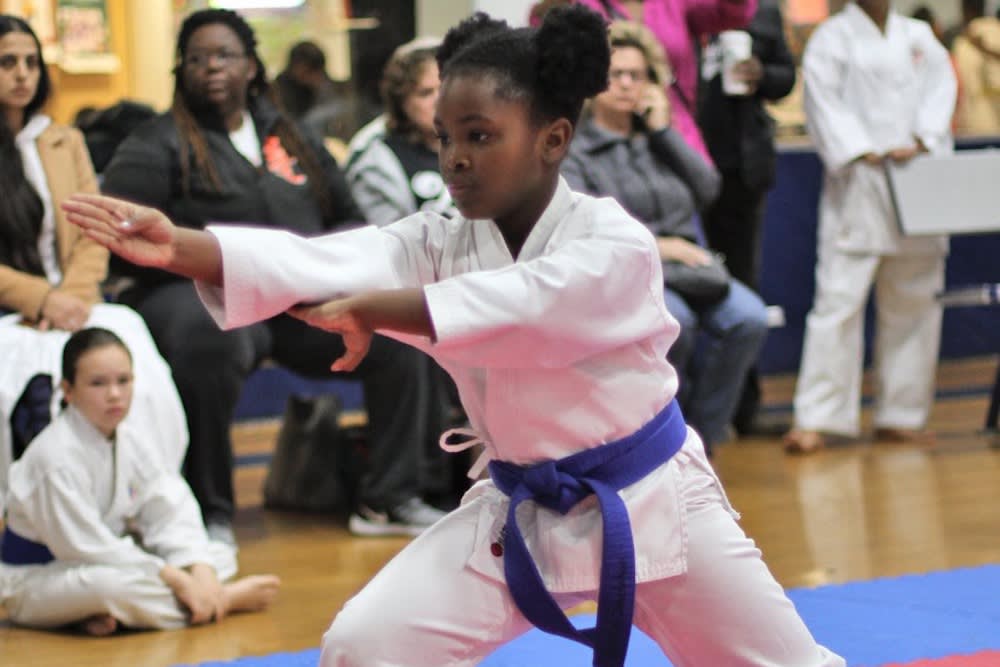
9. Kata The formal patterns which are the backbone of Karate
training. It develops form, style, balance, speed and
control. Kata trains the individual in the alertness of mind
and body.
10. What is Karate? It is an art through which a person trains his mind and
body. It is a method of perfecting oneself; it is a way of
learning to live, making a better person, overcoming
fear, learning humility and self-discipline.
11. Dojo Precepts Humility – To be humble.
(Dojo Kun) Self Control – To control your emotions and actions.
Integrity – To be honest and trustworthy.
Courtesy – To have respect for yourself and others.
12. Arigato gozaimashita Thank you.
13. Onegaishimasu Will you please teach me
1. Think Karate in the Dojo. Devote yourself to Karate while in the Dojo.
Thinking about other problems will only divide your attention and make Karate less
rewarding. You will find that even strenuous workouts are refreshing when you
concentrate totally on the Karate experience.
2. Train Regularly. If you do not train regularly, you cannot lay a good foundation in
basics and progress. You also risk losing the rank you presently hold and
delay further promotions.
3. Do Your Best. Try to consistently expand your capabilities.
4. Pay Attention. By listening carefully to the Sensei, you can avoid careless mistakes
which may cause injuries. You can also pick up pointers, which will
improve your technique.
5. Kindly Help Beginning Students – if you are already an advanced student.
6. Do not lose your temper. Especially during sparring sessions.
7. Training is not only done in the dojo. Practice at home whenever possible.
8. Don’t be a Dropout. When your spirit is low or you are losing interest,
talk to your Sensei.
9. Take proper care of your uniform. Wash your gi regularly and fold it
properly after practice.
10. Respect the Dojo. Bow when entering or leaving the training area. Always keep the dojo
clean. Don’t wait for someone else to tell you to clean up. Do it yourself.
11. Absolutely no Horseplay in the Dojo. The atmosphere of the dojo should be serious in
order to avoid needless injuries. No one below the rank of brown belt should engage
in free sparring without the supervision of an instructor.
12. Keep fingernails and toenails trimmed in order to avoid scratching a sparring partner.
It is also not possible to form your fist properly for thrusting with long nails.
13. Tardiness. When class is in progress, students who arrive late should meditate,
warm up if necessary, and then join the class in a quiet and orderly manner.
14. Avoid cigarettes and alcohol before training. Eat meals at least one hour prior to
training. Do no chew gum in class.
15. Respect the Sensei. At the dojo, bow to your Sensei when entering and upon
leaving the training area. At all karate functions
(tournaments, meetings, parties, etc) bow to your Sensei upon arrival and
again at departure. Never address your Sensei by his/her first name.
(Sensei refers to Sensei Serge Clark and all Okinawa Karate Kobudo Kai Instructors)